

 Joomla hacked?
 Joomla 6 migration
 Security update PHP & YOOtheme
 Blog
 References
 About us
 Prices
 Contact

Backup in, report out: newtastic Afterhack investigates a hacked Joomla site from its Akeeba backup. After about a minute the program shows what was changed, where backdoors are, how the attackers probably got in and what to do next. It runs on Windows on your own computer, including the AI that judges suspicious files. Nothing is uploaded. Afterhack grew out of our own hack investigations – the steps behind it are described in Joomla hack: preserve evidence, clean up, report.
Key points
- Every file against the original: checksums of all Joomla versions from 3.2.4 are built in.
- Backdoors and the way in: own rules from real cases, several established rule sets, known vulnerabilities in the core and in extensions, server logs if you add them.
- Local AI as a second opinion: it judges every suspicious file and explains why, without data leaving your computer.
- Through to the end: report template, cleaned copy, a list of credentials to change, reporting channels for a data breach.
- Pre-release for Windows 10 and 11, currently Joomla only and with a German interface. No finding does not mean “clean”.
Why a tool of its own
Investigating a hacked Joomla site means doing the same things again and again: open the backup in an isolated copy, compare every core file with the original package, search all files and the database for patterns, analyse the server logs, build a timeline and finally write a report that also works for the notification to the data protection authority. By hand this takes hours, and every forgotten step can leave a backdoor behind. Afterhack runs these steps in the same order every time and shows where every hint comes from.
How it works
- Drop in the backup: an Akeeba backup (
.jpa, multi-part too, or.zip). Afterhack keeps a copy in the case and records a SHA-256 fingerprint. - Read the overview: after about a minute it shows the Joomla version, changed core files, files rated high and known vulnerabilities.
- Add traces: server logs show the attackers’ path, the local AI judges the suspicious files.
- Finish: complete the report, create a cleaned copy, change credentials, check the reporting channels. A checklist with 21 steps in five phases guides you through the case.
What Afterhack checks
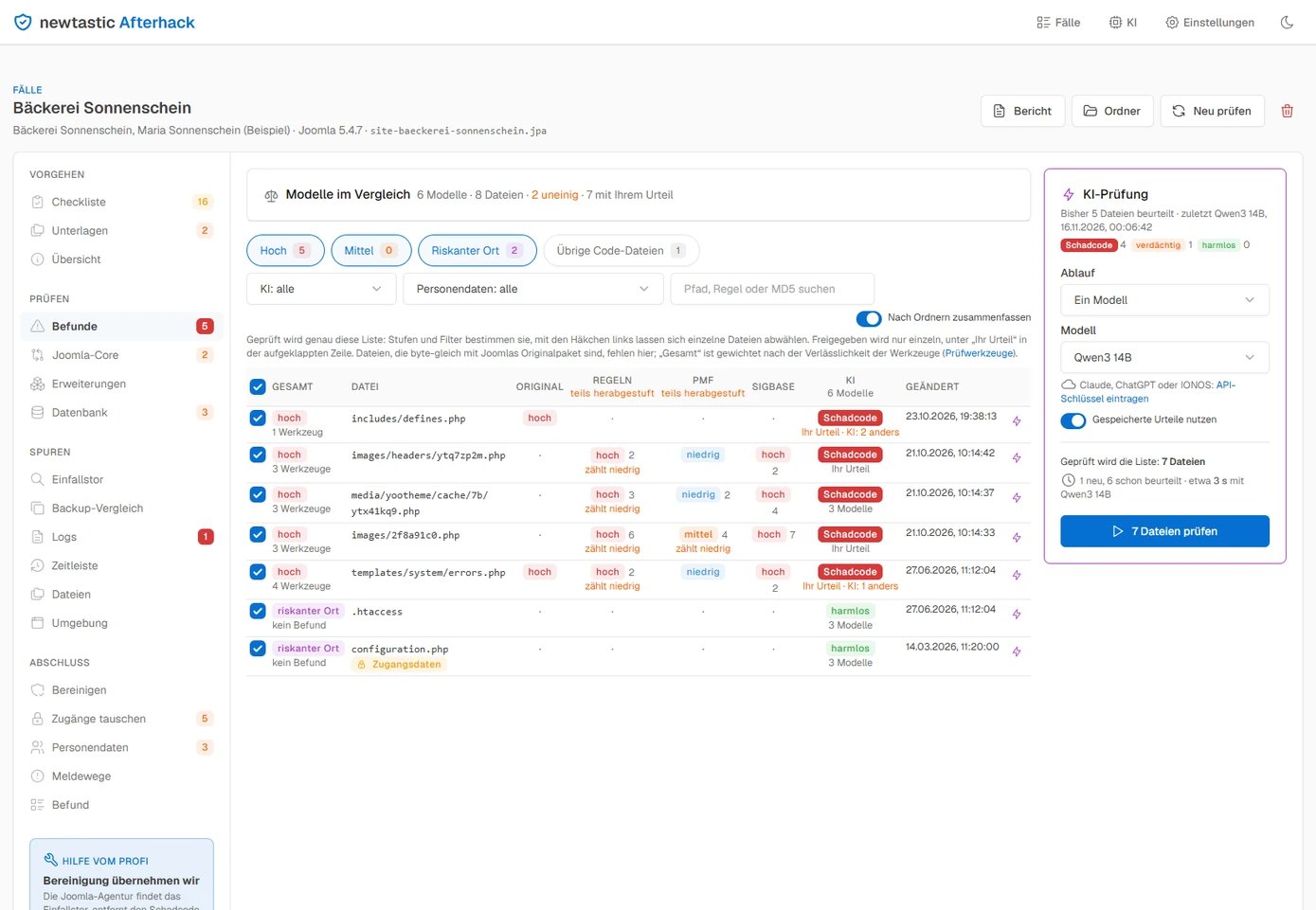
Every file against the original
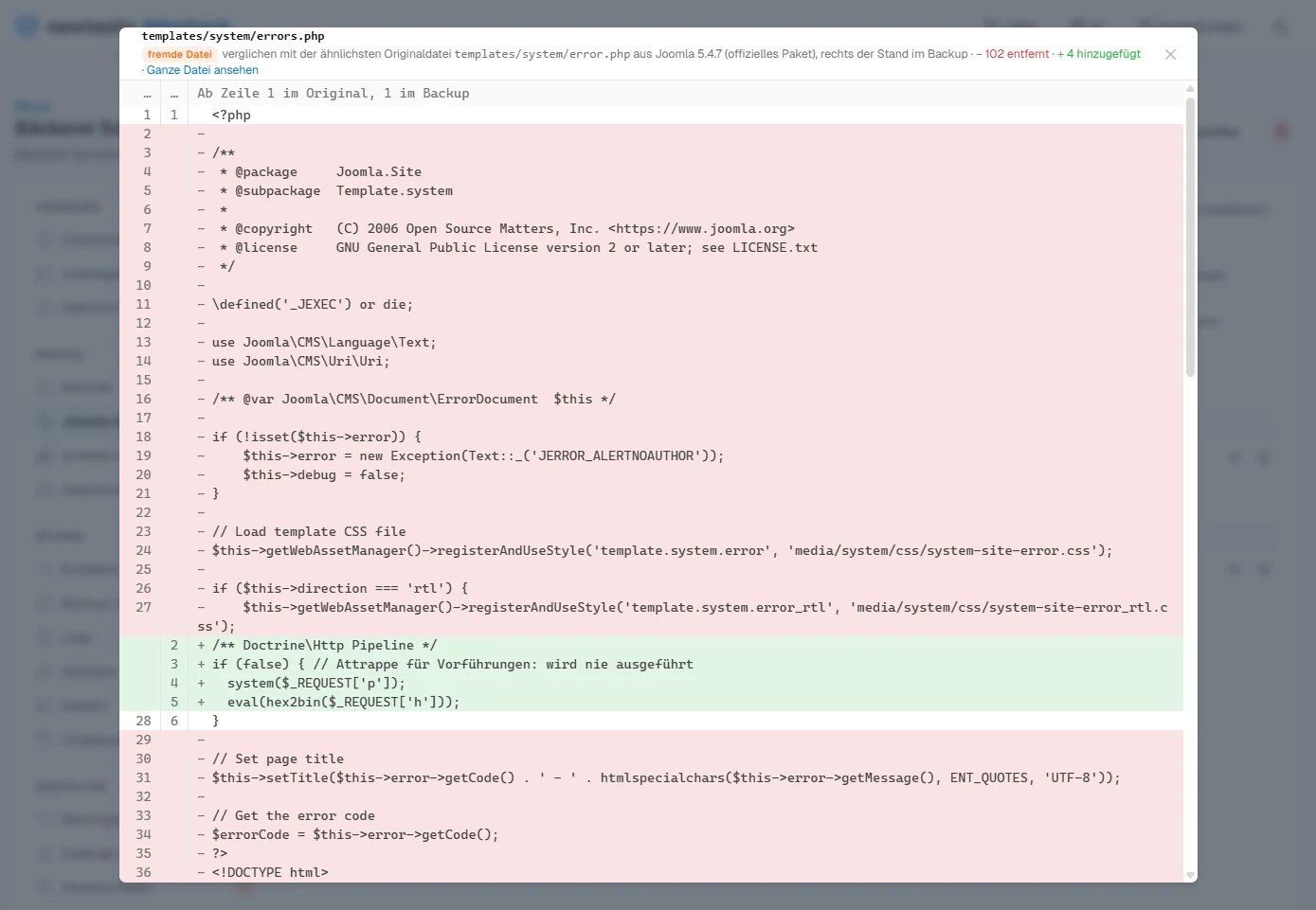
Checksums of all Joomla versions from 3.2.4 are part of the program. Changed and foreign files in the core and leftovers of old versions stand out at once. Changed core files can be compared line by line with the original; a disguised file such as defaults.php next to default.php is compared with the most similar original file in the same folder. Original packages of freely available extensions come from the vendors’ update servers, purchased packages can be uploaded. Whatever is byte-identical with an original package drops out of the findings.
Finding backdoors
Afterhack searches with own rules from real cases (PHP in images, disguised web shells, .htaccess tricks), known backdoors by checksum, YARA-X with the rule sets php-malware-finder and signature-base, plus the signatures of Linux Malware Detect and web server rules from YARA Forge. Every tool is listed with origin, license and version in the settings. Afterhack measures across all cases how often a rule was right; rules with many false alarms count less. False alarms such as the remote maintenance of mySites.guru are in a signed list of known harmless files – only by their exact content, never by location alone.
Finding the way in
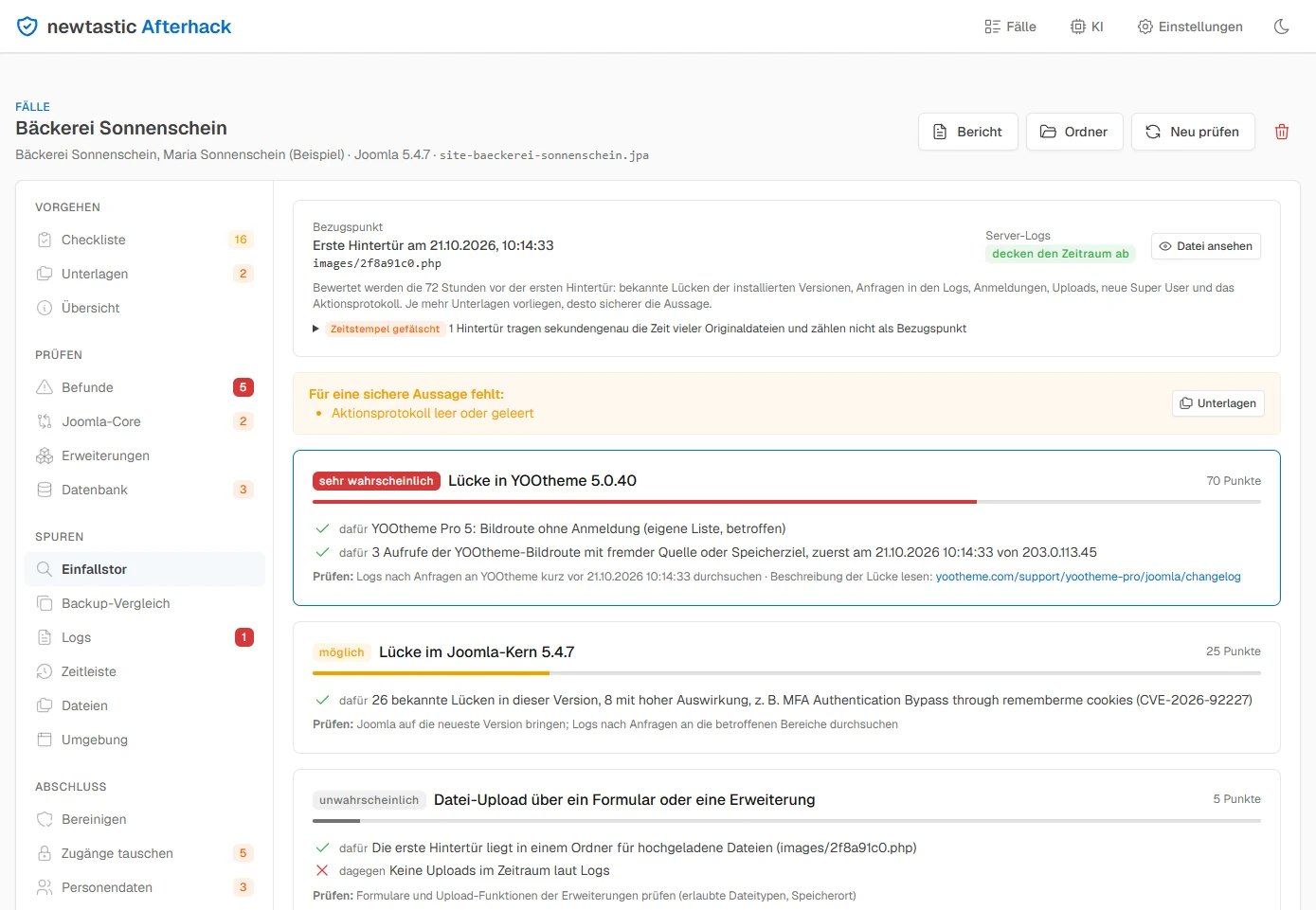
The reference point is the first backdoor. For the 72 hours before it Afterhack evaluates known vulnerabilities of the installed versions (all core issues from the Joomla Security Centre, the Vulnerable Extensions List and an own list such as the YOOtheme Pro 5 image route), requests in the server logs, logins, uploads, new Super Users and the action log. Every assumption comes with evidence for and against and a rating from “very likely” to “unlikely”. Backdoors that took over the timestamp of original files are recognised and not used as the reference point.
Database and server logs
Afterhack reads the database straight from the dump in the backup: injected scripts, iframes and spam, Super Users with and without two-factor authentication, an emptied action log. Server logs from Apache or nginx, compressed too, appear as attack waves matching the file times, with the traces per address. Two backups of the same site can be compared file by file; new code without evidence from an original package comes first.
Local AI as a second opinion
An AI on your computer (llama.cpp with openly available models) reads every suspicious file and explains its verdict, which you can follow live. Afterhack suggests the model that suits your computer: three recommendations – “most accurate”, “balanced”, “fastest” – are based on measurements with real backdoors and harmless but suspicious-looking code. The AI also runs on the processor, much faster with a graphics card from 8 to 12 GB. Several models can be compared side by side, and your own verdict per file counts too.
Changing credentials, personal data, reporting
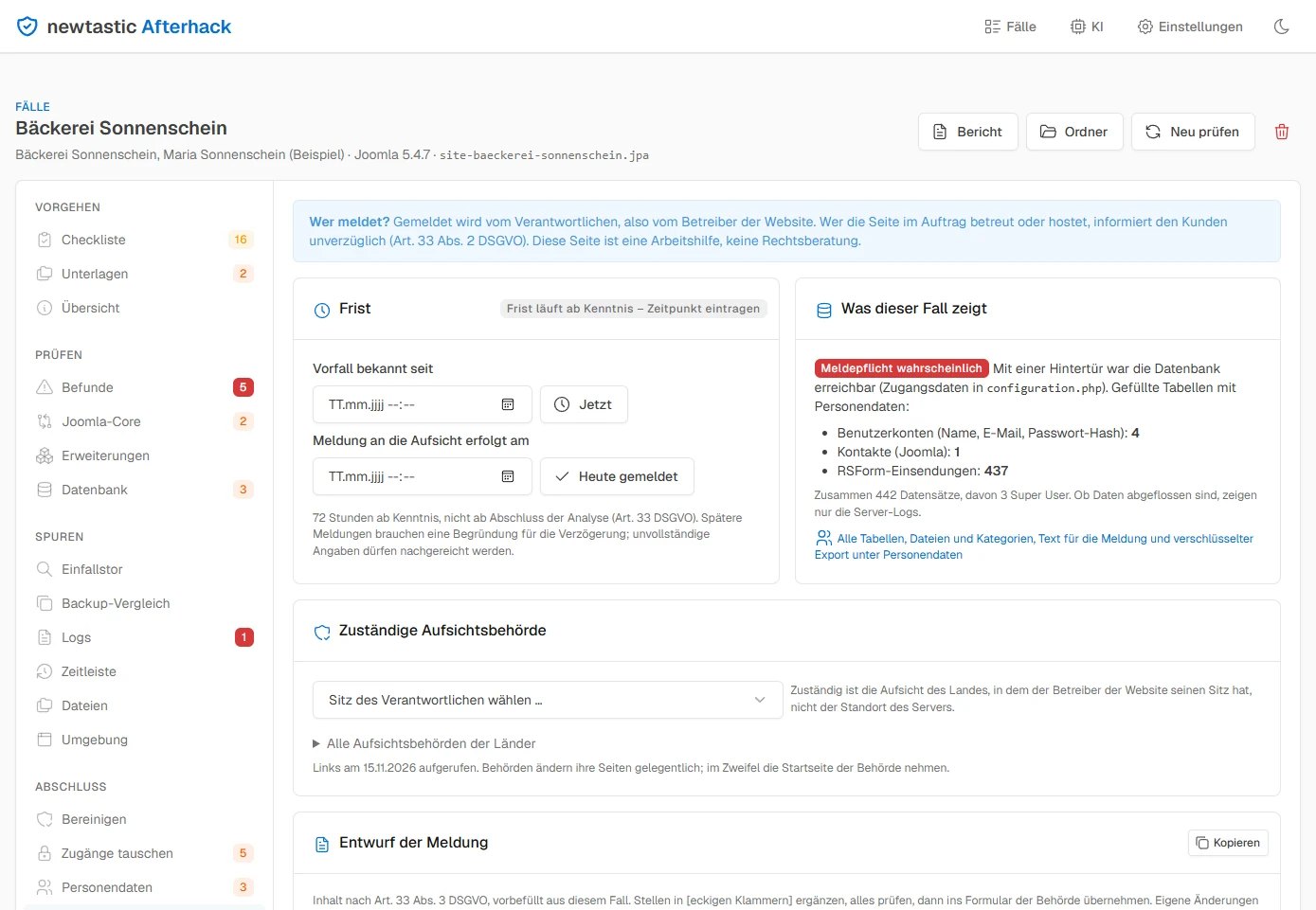
Afterhack searches the backup for everything the attackers could read: database, mail and FTP passwords, Joomla’s secret, API keys in extensions, targets of the Akeeba profiles. Every finding is listed with its location and instructions in a checklist; only masked hints are stored. For a notification under Art. 33 GDPR it shows the tables with personal data, the number of records and an estimate of the people affected. The “reporting channels” view counts down the 72 hours, names the competent German supervisory authority per state and drafts a notification from the case data – a working aid, not legal advice.
Report and cleaned copy
The report is a template in the structure of a hack analysis – result, findings, timeline, way in, data affected, next steps – and is versioned with every change. Cleaning means a plan to review, a cleaned copy as a ZIP with Akeeba restore, the quarantine as an encrypted ZIP and SQL to block accounts. Afterhack checks the cleaned copy right away. With Docker Desktop the site can also be started and viewed in a network without internet access.
Your data stays on your computer
Backups contain customer data and passwords. That is why the investigation and the AI run locally and nothing is uploaded. Outgoing connections only download: updates of rules, vulnerability lists and checksums, AI models, original packages and the check for a new program version at newtastic.de, which counts installations anonymously and can be switched off. An external AI (Claude, ChatGPT or the IONOS AI Model Hub) is only used if you enter a key yourself and confirm it per case. Files with personal data or credentials never leave even then, and in all other texts e-mail addresses, phone numbers, IP addresses and IBANs are blacked out first.
Limits
- Pre-release: this post describes version 0.1.0-beta.3. New versions come signed from newtastic.de and install at the press of a button.
- Joomla only for now, and only an Akeeba backup as the source. Further PHP systems such as WordPress are planned but not included yet.
- Windows 10 and 11, installer without administrator rights or a portable version; the interface is German for now. Windows SmartScreen may warn on first start because the program is not yet signed with a certificate.
- No finding does not mean “clean”. Afterhack can miss malicious code and flag harmless files; AI verdicts can be wrong too. All results are hints, not a substitute for review by a qualified person.
- Built with AI: the program code was generated with AI, and the terms of use say so openly. There is no entitlement to support or updates.
Download Afterhack
Installer, portable version and terms of use are on the product page at newtastic (in German): newtastic.de/afterhack.
Rather have help straight away? We investigate and clean hacked Joomla sites as a paid service – with exactly this tool: Joomla hacked: how we help.
To keep it from coming to that: in our Joomla maintenance contract we install security updates as soon as they are released.
Afterhack is a program by newtastic GmbH in Berlin, the people behind Joomla Agency. The pictures show an invented example case (“Bäckerei Sonnenschein”) with harmless dummies instead of real malicious code.


